Our fears have an expiration date. Its expiration date is when you decide to face them.”
- Pastor Suzette DeSouza
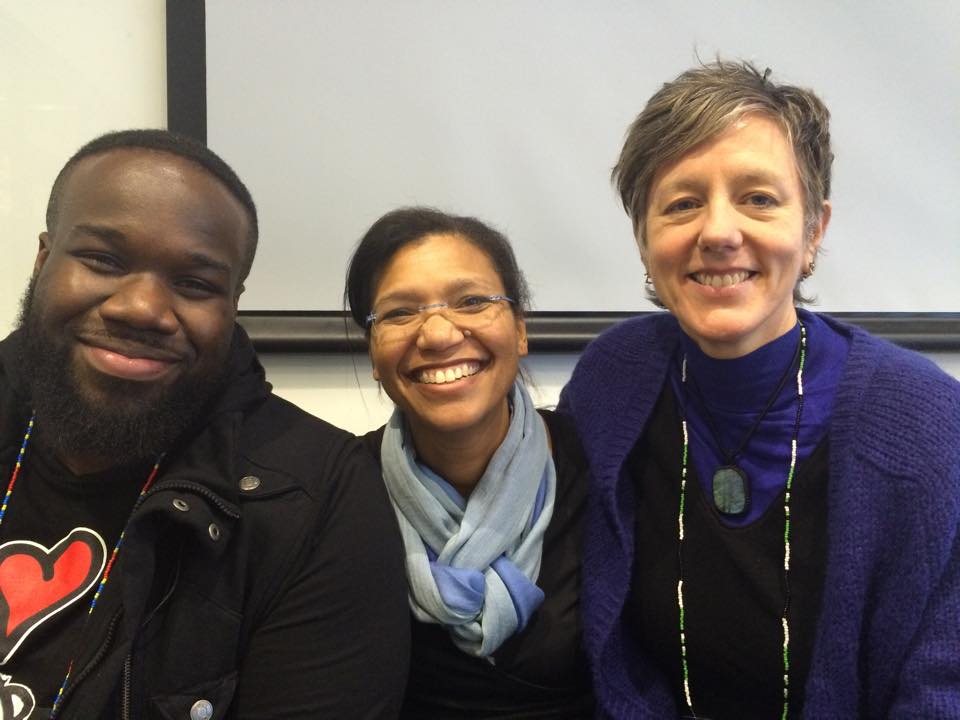 11/19/2014- Myself, Tuesday Ryan-Hart, and Kelly McGowan at the Center for Social Innovation in New York City
My friends Tuesday, Kelly, and Nancy, and I hosted a two day practice-based theory and skill-sharing training, “Creating Impact through Engagement” at the Center for Social Innovation in New York City last week. The day prior to the training I had checked in with the group sharing that I had been a little unsettled going into the design and preparation for the two day training, because I had administrative, and advisory tasks that I needed to take care of that were hanging over my head going into this training, and an informational webinar that I had to do for a philanthropy client actually during our time designing the training. The check-in definitely helped me, because I really wanted to put my energy towards being fully present for the two days acknowledging that probably everyone has work responsibilities hanging over their head. More importantly, we along with the active participants of the two day training were coming together because we all want to create space to explore what it takes to be more strategic and intentional about how we are making transformational change happen within our organizations and communities.
It was after the check-in that I decided that I wanted to place an expiration date on my fears going into the training. I wanted to be vulnerable and share a story about me personally that could be connected to some of the practices and frameworks that we were sharing with the group. I usually find myself during training or workshop explaining ideas, theory, practice, and directions. I wanted to allow myself to have the courage to share a personal story that I thought could ground myself and participants in my lived experience that could frame the importance of the theory being taught rather than explaining it away. I saw it as an opportunity to practice what it meant for me to use lived experience as a teachable moment. In addition, my first blog on Power & Privilege 2.0 was also based on this teach I was about to frame. The following day, I actually set up the framing for the 2 loops theory teach and exercise that Tuesday facilitated. I chose the law enforcement system as the backdrop to my personal story and began to share with participants my understanding of the history of law enforcement and how the beginnings of law enforcement in America have direct and close ties to slavery in this country through slave patrols.
Continuing my story, I fast forward in history to talk about my family’s encounter with police when my father attempted to attack my mother with a knife. It was not my parent’s first encounter with domestic violence. The difference this time was that it was their last incident, because several months after, it led to my parents’ divorce. I shared with participants what happened when the police came to the house, and charges processed against my father for aggravated assault against my mother. I talked about how my parents couldn't afford the lawyer and court fees associated with the charges, and how the charges were eventually were dropped. I then asked participants how they might think my parents, the police, and their children- my sister and I were affected and impacted by what took place? Did we get an opportunity to reconcile with what had happened? Did anyone get the opportunity to heal or even forgive? What role did my parents and the law enforcement system play in all of this? Lastly, how do I deal with this past lived experience as someone who is now in the role of figuring out how to address issues of violence in communities all across the nation? Once I framed this for participants I then transitioned Tuesday into the 2 loops teach and exercise.
Reflecting back on the framing that went into the exercise, I could have:
a) Talked about and named how my father was being paternalistic towards my mother and how patriarchy, class dynamics, and race showed up and law enforcement’s reaction to them, but I didn’t.
b) Talked about the issues my mom had in trying to engage my father in healthy dialogue around their relationship and the kind of relationship she wanted with him and what got in the way of that, but I didn’t.
c) Talked about how the incidents of domestic violence impacted the relationship I had with my father, and how I felt like I was never enough in his eyes, but I didn't, and actually that is okay.
It’s okay, because I didn't want to share my story while also giving you my political analysis to my story. My narrative is a part of me and I know what it means for me to share that publicly to a larger audience. I shared my story because I had an intention behind why I wanted to share it. I shared it because I felt it was important for me to acknowledge and practice being vulnerable and seeing my vulnerability as strength. How can any of us cultivate our own analysis if we continue to place our own onto others? Where is our agency in that? I wanted to host myself and participants in my experience rather than providing analysis and recommendations about my experience. My experience of violence can’t be solved in a policy memo, nor a cereal box, cookie cutter, behavioral intervention. It’s not enough.
We spend time studying other people, collecting evidence of what is wrong with them or us as a means to justify why we need to approach situations, and people in a way that makes our problems into commodities. This limits the opportunity for people to practice building critical and compassionate connections within ourselves and each other. We need to seize the time and spend it building our own awareness of ourselves, others, and our environment, so that we can truly show up to be who we are past, present, and future instead of hiding behind our analysis of what we think ought to be or should be, when we may not even be showing up in that way ourselves.
So friends at this juncture I have decided to commit myself to abandon the practice of diagnosing oppression with its authoritative recommendations on how to be less racist, sexist, heterosexist, and instead practice discernment with how people are showing up by being inquiry about the following:
When was a time that I faced adversity in my life and what did I do to overcome it? What was challenging about that adversity? What was at stake for me?
What have I done to contribute to the very thing I complain about or want to change?
When did I hold a belief about someone or something that I found out was not true? How did it affect or impact me? How did I react once it was revealed to me? What did it take for me to make my revelation a new possibility that was more just for all?
I am sure I will be experiencing some loss in practicing letting go, and I will always remember that I am not just my analysis. I am also made up of stories and experiences too that I want to share with friends and loved ones, and I don’t owe anyone an explanation of my story. Trust me, I wouldn't want anyone to study me through a 12 step how-to book on how to figure out to make sense of and understand my complex life.
P.S: Here are Power and Privilege 2.0’s hash-tags. Spread your love for us widely with style and grace: #powerbeyondprivilege #beyondtolerance #poweramongus #equalityisnotequity

 RSS Feed